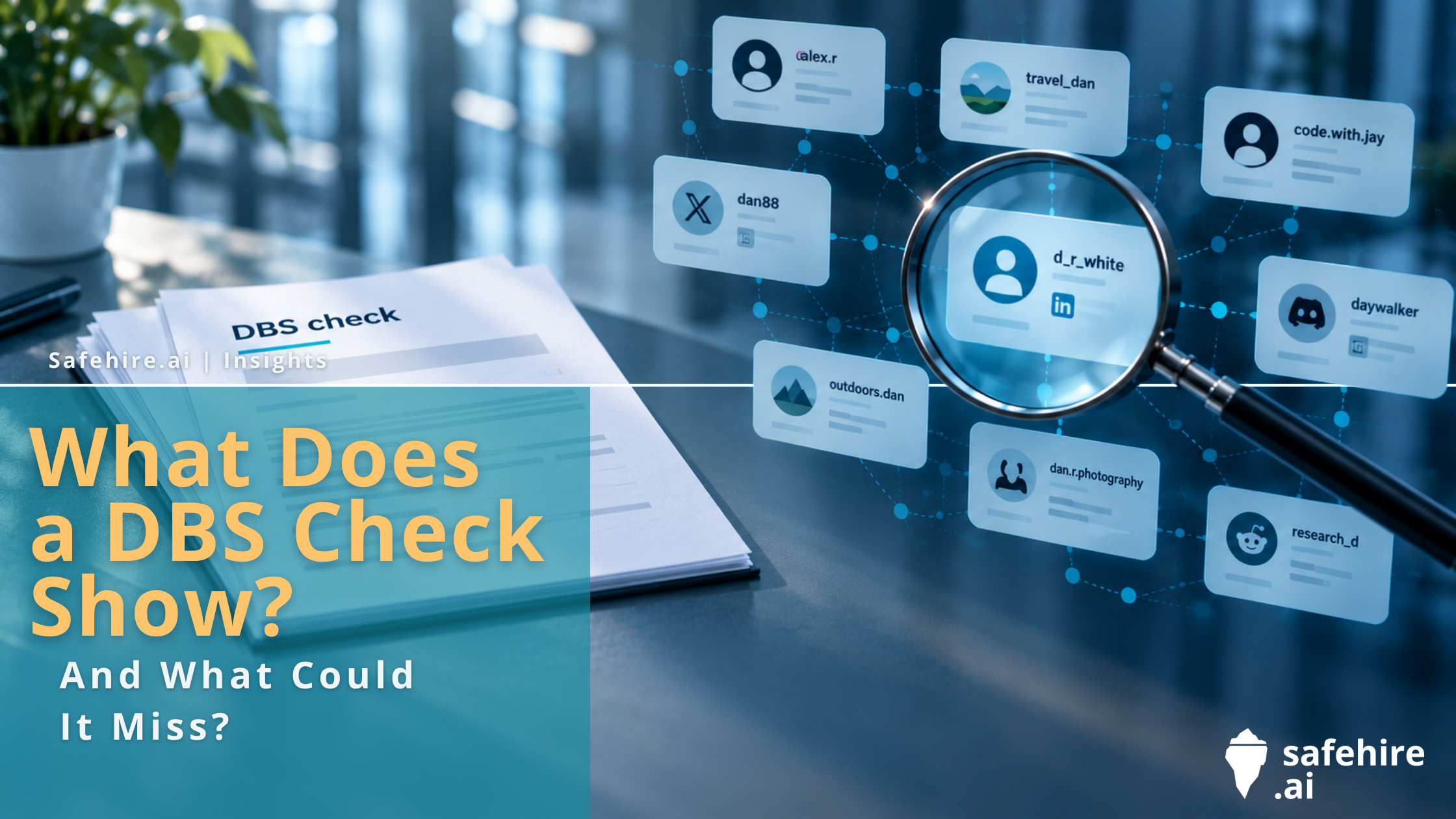
A DBS check can show criminal record information and, depending on the level, relevant police information and barred list status. What appears depends on the check, the role’s eligibility and the rules governing disclosure.
For an employer making a recruitment decision, it provides important evidence.
It can also leave a question unanswered: could there be relevant activity under an online identity that has never been connected to the person in front of you?
A certificate does not provide a complete account of someone’s digital life. Understanding that boundary matters when the role involves children, vulnerable adults, sensitive information or trusted access.
What does a DBS check show?
In England and Wales, the main differences are:
- Basic: unspent convictions and conditional cautions.
- Standard: spent and unspent convictions and cautions held on the Police National Computer, subject to filtering rules.
- Enhanced: the Standard information, plus relevant information held by local police that ought to be disclosed.
- Enhanced with barred list checks: the Enhanced information, plus the relevant children’s and/or adults’ barred list check where the role is eligible.
Employers must establish which level they are legally entitled to request. An Enhanced check does not automatically include a barred list check.
For the full comparison, read DBS checks explained: what each level shows and what they all miss.
The important point here is the boundary. A DBS check discloses information within a defined process. A clear certificate means no information was disclosed on that particular check. It cannot settle every question about someone’s suitability for a role.
Does a DBS check show internet history or social media?
A DBS check does not give an employer access to someone’s private browsing history. It is not a general search of their social media accounts, forum posts or wider digital footprint.
Online conduct can still be relevant to a DBS disclosure. If it has resulted in a conviction, caution or relevant police-held information, it may appear where the applicable disclosure conditions are met. An Enhanced certificate can include relevant non-conviction information.
The distinction matters. Reviewing information held by the police and investigating someone’s online activity are different processes.
An employer can therefore complete the appropriate DBS check and still have unanswered questions about role-relevant activity elsewhere.
What happens when someone uses an online alias?
A name on an application form is only one way a person can be identified.
People use usernames, pseudonyms and separate accounts across platforms. Many do so for ordinary reasons: privacy, a hobby, professional separation or participation in a community. An alias alone gives an employer no basis to assume wrongdoing.
The practical difficulty arises when potentially relevant material sits under a username with no obvious connection to the applicant’s everyday identity.
DBS applications ask for current and previous names. Employers should follow the applicable identity-checking process and resolve discrepancies. Those requirements should not be confused with an investigation into every online account a person may have used.
An alias does not automatically defeat a DBS check or mean that a conviction will be missed. Equally, a clear certificate does not establish that all relevant online identities have been identified and assessed.
The unanswered question is whether relevant activity exists, whether it can reliably be connected to the individual, and whether it matters to the role.
The difficult part is proving the connection
Consider a hypothetical school recruitment decision. The appropriate DBS check has been completed. A separate digital review identifies concerning material under a username that may be associated with the candidate.
The school now needs more than a screenshot.
Who controls the account? What supports the connection? Is the material authentic? When was it published? Does the surrounding conversation change its meaning?
A similar name or reused username is not enough to establish identity. Someone may have been impersonated. A quotation may have been mistaken for an endorsement. An isolated post may leave out information that changes the assessment.
The opposite mistake is possible too. Relevant evidence should not be dismissed simply because it falls outside the scope of a DBS certificate.
Whoever owns the recruitment decision needs a clear account of what has been established, what remains uncertain and why the material is relevant. The candidate should have an appropriate opportunity to explain or challenge it before a decision is made.
Under recruitment pressure, an unexplained flag can create as much confusion as it resolves.
What can digital risk screening add?
Digital Risk Screening can provide an additional, role-relevant source of information alongside DBS checks, references and other recruitment safeguards.
The useful work goes beyond finding an account. It involves examining potential connections, investigating context and explaining the significance and limits of the evidence.
At Safehire, AI-assisted research surfaces potential digital-risk associations. Trained human analysts review reportable positive findings for attribution, relevance and context before they are issued. The employer remains responsible for the decision.
Safehire’s four safeguarding categories are child sexual exploitation, radicalisation, hate speech and high-risk organisations. Two additional categories for relevant commercial and high-trust settings address criminal crypto activity and hacking activity.
The scope should reflect the role and the purpose of the check. Ordinary cryptocurrency use, lawful security research or the existence of an account should not be treated as evidence of criminality.
No screening service can identify every account, recover every piece of content or guarantee future conduct. A potential association needs investigation. Where identity or context remains uncertain, the report should make that uncertainty clear.
What should an employer do with the gap?
The aim is to answer the questions that matter to the appointment without collecting irrelevant information about someone’s private life.
A workable approach is to:
1. Complete the appropriate DBS check. Confirm eligibility and follow the required identity process.
2. Define what remains unanswered. Be specific about the responsibilities, access or safeguarding exposure that may justify additional checks.
3. Set a lawful, proportionate scope. Establish the purpose, lawful basis, candidate information, access controls and retention arrangements before additional screening.
4. Require evidence behind a finding. Check attribution, authenticity, timing, context and role relevance. Separate an allegation or possible association from an established fact.
5. Give the person an appropriate opportunity to respond. Correct mistakes and consider their explanation before reaching a conclusion.
6. Record the judgement. Name the decision owner and explain what was considered, what remained uncertain and why the outcome was proportionate.
Additional information earns its place when it helps someone make a better-informed decision. More screenshots alone will not do that.
What does a clear DBS check leave you knowing?
A clear certificate tells you that no information was disclosed through that check. It is valuable evidence within its scope.
It does not tell you that every relevant online identity has been found, that every concern has reached the police or that future conduct is guaranteed.
For employers, the next step is to understand which questions remain and whether further, proportionate checks would help answer them.
Could your current recruitment checks identify relevant activity beyond an applicant’s obvious public profile? Talk to Safehire about where human-reviewed Digital Risk Screening could fit alongside your existing process.