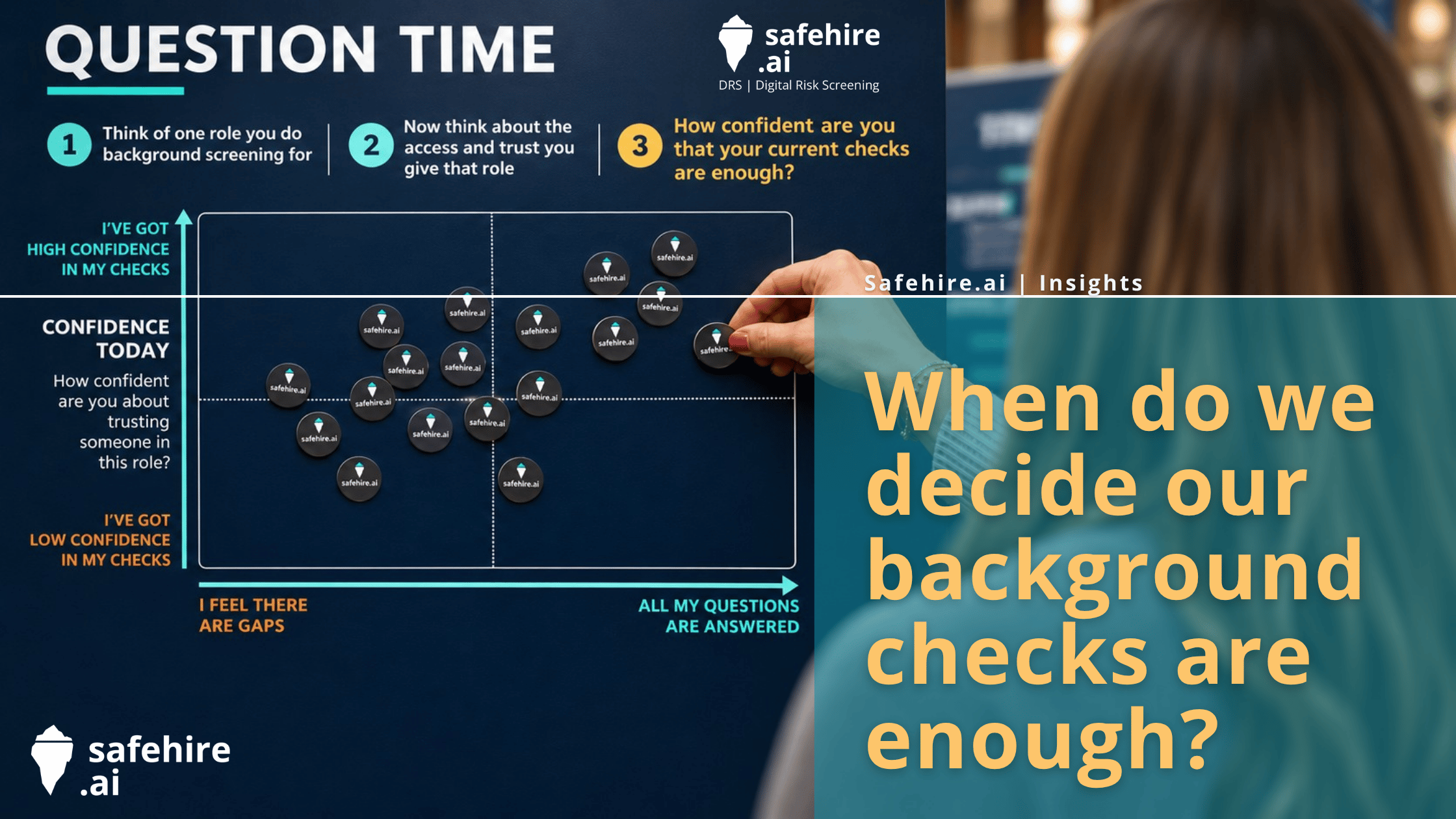
At the Background Check Advisory event, we asked a room of screening professionals to think about one role, the access and trust it carries, and whether the checks currently used for that role are enough.
People placed stickers on a board to show how confident they felt and whether they believed questions remained unanswered.
The responses appeared on both sides of the board. Some indicated confidence while also recognising gaps.
It was an informal exercise, not research, and we can’t know why each person put their sticker where they did. It did leave me with a question I think our industry should keep asking.
Are we confident because we’ve carried out the checks we’re supposed to? Or because we can explain how those checks help us understand the risks associated with the role?
What does “enough” mean?
Identity checks, employment history, qualifications and criminal records all have an important place in screening. They give employers evidence they need to make decisions.
Completing an agreed set of checks is an important part of the process. It is also worth asking how that set was agreed in the first place.
What does each check tell us? How does it relate to the access and responsibilities involved? Which questions sit outside its scope? Most importantly, who has decided that the remaining uncertainty is acceptable?
A screening provider and an employer may have a sensible answer to those questions. My point is that they should be able to give one.
A useful challenge to our confidence
The Association of Certified Fraud Examiners’ 2026 Report to the Nations found that 88% of the occupational fraud perpetrators in its study had no known prior fraud-related charges or convictions at the time of the offence.
That does not tell us a background check failed, or that another type of screening would have identified those cases. It does illustrate a limitation: a criminal history check can only tell us about information within its scope. A clear result cannot answer every question about risk.
The question for our industry
I think there is an opportunity for screening providers to have a more explicit conversation with clients about what their checks are designed to establish, and where the limits sit.
The answer will vary by role. More checking is not automatically better. The aim should be a proportionate process that gives the decision-maker relevant evidence and a clear understanding of what remains uncertain.
At Safehire, we see digital-risk insight as one possible additional input alongside conventional checks where it is relevant to the role. It can help inform a decision, but it cannot provide certainty or replace the other evidence an employer needs.
So the question I would leave with both screening providers and employers is:
What evidence would justify your confidence that the checks are enough for this role?